
On February 19-20 2025, the United Nations Technology Innovation Accelerator for Cities (UNITAC) and the Kyiv School of Economics (KSE) jointly hosted the conference Liberty, Equality, Innovations - Digital Tools and Data for Ukrainian Recovery. The two-day event brought together government representatives and experts from the public sector, businesses, academia, non-profit organizations and civil society in Kyiv and Hamburg. The first day took place at the Kyiv School of Economics, followed by a second day at UNITAC’s premises in Hamburg. In parallel the conference was broadcasted online, expanding its reach beyond both cities.
With 250 participants, nearly 900 online viewers of the conference recordings and 31 speakers, the conference created a powerful space to exchange ideas and experiences on how digital technologies, data, and inclusive urban planning can support Ukraine’s recovery, resilience, and sustainable development.
The event was co-organized by UNITAC within the framework of the Just Transitions in Vulnerable Places project, an initiative funded by the German Federal Ministry for Economic Cooperation and Development (BMZ) and led by UNITAC Hamburg in coordination with the UN-Habitat country office in Ukraine. The conference marked a key milestone in UNITAC’s engagement with Ukraine, promoting knowledge-sharing and critical reflection on the role of digital tools in informing and supporting recovery efforts. As part of the project, UNITAC is developing a spatial decision support system – the Urban Recovery Planning System (URPS) – which was presented in Kyiv. The tool, co-created with partner hromadas in Makariv, Irpin and Drohobych, in collaboration with the UN-Habitat Ukraine Urban Lab, provides a toolbox for analysis and visualization of urban profile data for more informed planning and decision-making, to support informed, inclusive, and resilient building and rebuilding efforts.
Day 1 in Kyiv: Recovery from a people-centred perspective
The first conference day focused on recovery from a people-centred perspective and raised the question of what recovery means for Ukrainian society. Mykhailo Leichenko from the Center for Innovation Development opened the conference with a keynote highlighting digitalization as a key enabler of urban resilience, accurate decision-making and effective planning.
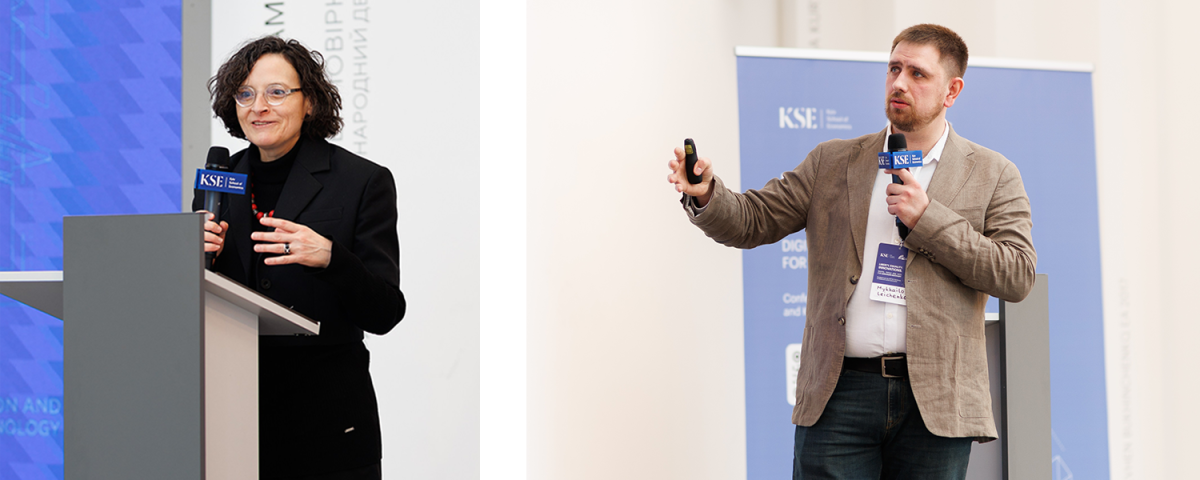
Photo left: Opening words by Gwendoline Mennetrier, UN-Habitat, Head of Office. Credit: Vasyl Tomchuk. Photo right: Mykhailo Leichenko, Center for Innovation Development. Credit: Vasyl Tomchuk
The first panel titled Agents of Recovery showcased Ukraine's diverse recovery landscape and featured projects initiatives and cross-sectoral recovery-themed digital tools from businesses, media, NGOs, and civil society. It introduced innovative use cases across sectors from cultural heritage to agriculture and the environment such as sea pollution. The initiatives aim to provide a data-driven, transparent, inclusive, and sustainable path to rebuilding, while also emphasising democratic participation and the preservation of Ukrainian heritage and communities. The panel further discussed who may currently be unrepresented and how they can be included in the conversation more meaningfully.

Photo: panel 1: Agents of recovery. From left: Dr. Tetiana Vodotyka, Yevheniia Drozdova, Hanna Denysenko, Vasyl Rozhko. Credit: Vasyl Tomchuk
The second panel titled Vision brought together perspectives from urban planners and researchers to explore the multi-layered nature of recovery and the existing approaches to its planning. The discussions explored the various aspects to Ukrainian resilience, examined the role of digital tools and geospatial data, and addressed critical issues of local capacity. The panelists also reflected on the role of the national government, academia, and businesses in facilitating a more equal distribution of resources, opportunities, and capacities across local stakeholders.

Photo: panel 2: Vision. From left: Dr. Alirza Mamedov, Mariana Kuzemska, Anna Kuzyshyn, Oleksandr Shevchenko. Credit: Vasyl Tomchuk
The day concluded with a keynote by Mykhailyna Skoryk-Shkarivska, Founder of the NGO Institute for Sustainable Development of Communities (ISDC). This public lecture emphasized the importance of communities adopting the best digital tools and practices. Ms. Skoryk-Shkarivska provided striking examples of how local governments instrumentalize digital tools for their resilience and join forces for facilitating their digital transition together.

Photo: keynote: Mykhailyna Skoryk-Shkarivska, Founder of the NGO Institute for Sustainable Development of Communities (ISDC). Credit: Vasyl Tomchuk
Day 2 in Hamburg: From Strategy to Implementation
Held at HafenCity University’s City Science Lab, the second day focused on how recovery efforts are being implemented and deepened the discussions on the role of international support in Ukraine's recovery efforts. The discussions on day 2 explored how advanced digital solutions, and technical expertise can be collaboratively adapted and integrated into Ukraine to align with the recovery vision that Ukrainians themselves have set.

Photo: keynote: Oleksandra Azarkhina, We Build Ukraine Foundation. Credit: Christian Schmidt, HCU Kommunikation
In her keynote presentation, Oleksandra Azarkhina from the We Build Ukraine Foundation stressed the importance of empowering communities and citizens by decentralizing the recovery process and making it people-centred. She noted that the current recovery phase marks a shift from strategic planning to practical implementation.
A panel of international organizations, including UNECE, U_CAN and CEOBS, shared localization strategies for digital tools and reflected on the challenges of contributing meaningfully within the Ukrainian context.

Photo: panel 3: Localisation. From left: Enkel Leskaj, Rob Watson, Shanmathi Rajkumar, Anja Berestetska, Credit: Christian Schmidt, HCU Kommunikation
The final panel highlighted real-world examples of how innovative technologies are driving Ukraine's recovery across various sectors, such as the circular economy and sustainable agriculture. It explored practical dimensions of recovery, focusing on locally adapted strategies that ensure effective and meaningful implementation.

Photo: panel 4: From Vision to Implementation. From left: Kateryna Lopatiuk, Olena Melnyk, Elena Orap, Frank Schwartze. Credit: Kim Duong
Asia Bazdyrieva from the University of Applied Arts in Vienna closed the conference with a critical post-colonial perspective on Ukraine’s recovery reflecting Ukrainian interests, visions, and values. The keynote highlighted the importance of viewing Ukraine as an active agent shaping its own future.

Photo: keynote: Asia Bazdyrieva, University of Applied Arts Vienna. Credit: Christian Schmidt, HCU Kommunikation
User testing session with Ukrainian municipalities and stakeholders
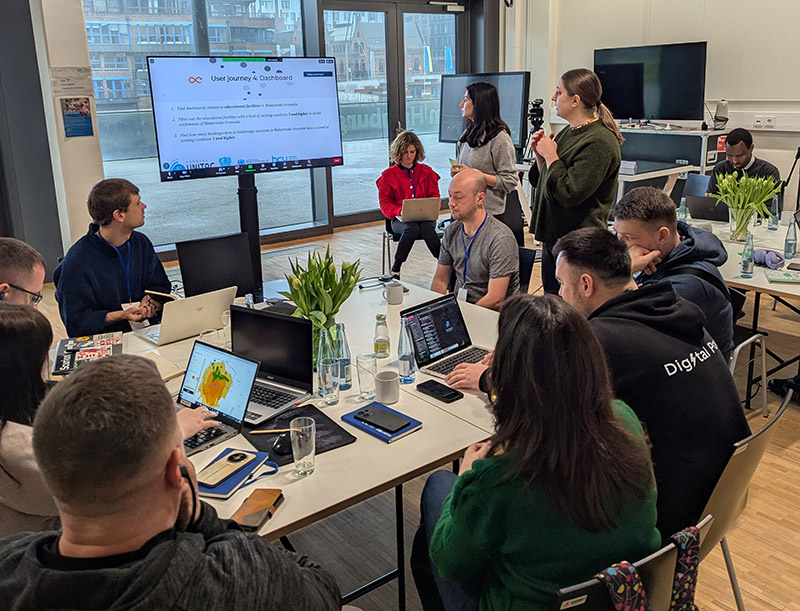
Photo: User testing session with Ukrainian municipalities. Credit: Anja Berestetska
Following the conference, UNITAC facilitated a user testing workshop with 8 local government representatives from Ukrainian partner communities. The session explored the Urban Recovery Planning System, a geospatial data platform developed under the Just Transition in Vulnerable Places project. Participants tested the system’s functionalities and user interface, and discussed how the toolbox can support local recovery efforts with data-informed tools tailored to municipal needs.
Watch the conference recordings
Recording conference day 1 in Kyiv
Recording conference day 2 in Hamburg
Author: Eva Stowasser
Published: 8 August 2025